Reflections from the Frontiers Symposium in Brazil
From 30 September to 2 October 2026, Belo Horizonte, Brazil, became a meeting point for researchers, practitioners, innovators, policymakers, and community leaders from more than 20 countries at the Frontiers Symposium: Community-led Circular Solutions for Inclusive Climate Action. Organized by the Royal Academy of Engineering in collaboration with WIEGO-Women in Informal Employment Globalizing and Organizing, the symposium created space for participants from diverse disciplines and backgrounds to exchange experiences,challenge assumptions, and explore pathways towards more inclusive and sustainable circular economies.
For me, one question stood out throughout the discussions: Who gets to shape the circular economy?
Across conversations on climate governance, community-led innovation, waste management, infrastructure, and finance, a common message emerged: circularity cannot be built for communities without being built with them. Cooperatives, informal workers, social enterprises, Indigenous communities, and local businesses are already developing solutions that reduce waste, create livelihoods, and respond to environmental challenges. Yet, their contributions are not always reflected in the decisions, investments, and policies that shape the systems they work within.
The symposium challenged us participants to look beyond viewing communities as beneficiaries and instead recognize them as active contributors and decision-makers. Their lived experiences, local knowledge, and understanding of their own contexts are essential to designing solutions that are practical, equitable, and sustainable. This perspective is particularly relevant to circular economy transitions, where the distribution of opportunities, responsibilities, and benefits matters as much as the environmental outcomes.
From local solutions to enabling ecosystems
Another important takeaway was that successful circular economy models cannot simply be replicated from one context to another. Context matters. Trust matters. Local knowledge matters.
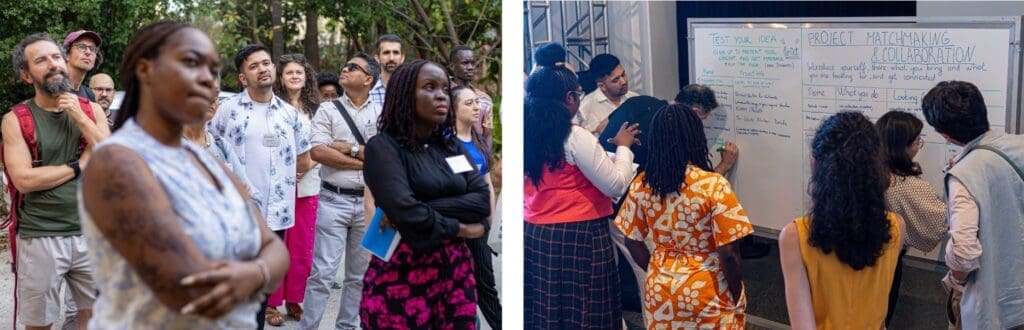
Through discussions on community-led circular ecosystems and innovation, we explored how locally rooted initiatives can connect with wider systems without losing their connection to the communities and places they serve. The conversations highlighted the importance of trust, community readiness, appropriate technology, and collaboration among businesses, civil society, municipalities, researchers, and governments. The discussions also turned to what enables these initiatives to grow and endure. Promising solutions can struggle to move beyond pilot stages when access to finance, supportive governance, resilient infrastructure, technical skills, or institutional coordination is missing.
Scaling community-led circularity therefore requires more than investing in individual enterprises or technologies. It calls for enabling ecosystems that make resources accessible, strengthen local capacities, and ensure that the people closest to the challenges can meaningfully participate in shaping the solutions.

Learning across disciplines, countries, and experiences
One of the most rewarding aspects of the symposium was connecting with people from different countries, professional backgrounds, and walks of life. Although we arrived with distinct experiences and perspectives, we were united by a shared goal: advancing inclusive climate action and building more just and resilient circular systems.
The exchange of ideas reinforced the value of bringing engineering, environmental sciences, social sciences, economics, policy, business, and community knowledge together. Each discipline offers a different lens, but meaningful progress happens when these perspectives inform one another.
Beyond the formal sessions, the conversations, shared experiences, and connections created wonderful memories. The symposium was a reminder that international collaboration is not only about exchanging knowledge; it is also about building relationships, discovering common ground, and creating possibilities for future partnerships.

Bringing the learning home to Nepal
Coming from Nepal and working at the intersection of circular economy, entrepreneurship, and inclusive innovation, I found these discussions particularly meaningful. They reinforced the importance of strengthening the ecosystems that enable enterprises and communities to develop circular solutions while ensuring that inclusion is embedded throughout the process. For Nepal, this means continuing to connect entrepreneurs with finance, skills, markets, networks, and supportive institutions, while recognizing the role of local communities and workers in the transition. It also means looking beyond individual business models to consider the wider systems that determine whether circular solutions can thrive.
The symposium offered an opportunity to reflect on how international experiences can inform locally relevant approaches, not by replicating models, but by adapting ideas through collaboration, local knowledge, and a deeper understanding of context. I return from Brazil with new perspectives, meaningful connections, and the hope that some of these conversations will develop into collaborations that translate ideas into action. My gratitude goes to the Royal Academy of Engineering, WIEGO, the Circular Economy Thematic Chamber, and all the symposium participants for creating a space where diverse perspectives and lived experiences could come together around a common purpose.
Ultimately, the real frontier of circularity may not be finding better solutions alone. It may be building systems in which the people closest to the challenges have the voice, resources, and power to shape them. Because a truly inclusive circular economy is not just about keeping materials in use, it is about ensuring that people and communities have a meaningful place in shaping the future.