I spent three weeks in the U.S. this summer on the International Visitor Leadership Program (IVLP), a flagship professional exchange initiative of the U.S. Department of State, as one of five Nepali professionals recommended by the U.S. Embassy.
The program was part of IVLP’s Freedom 250 initiative, celebrating the United States’ semiquincentennial with hundreds of international leaders taking part. Out of 8 different topics, I was under “AI Innovation and Security”: 20 participants (government officials, academics, entrepreneurs, and people from industry associations and NGOs) from 19 countries and the European Union, all working on AI policy, innovation, or capacity building.
We looked at U.S. technology policy and AI research, how public, private, and academic partners build and deploy AI responsibly, how AI can grow the economy and create jobs, and where predictive systems are being used. Meeting after meeting, the same point came back: the technology is only part of it. The rest is responsibility, trust, and working across borders.
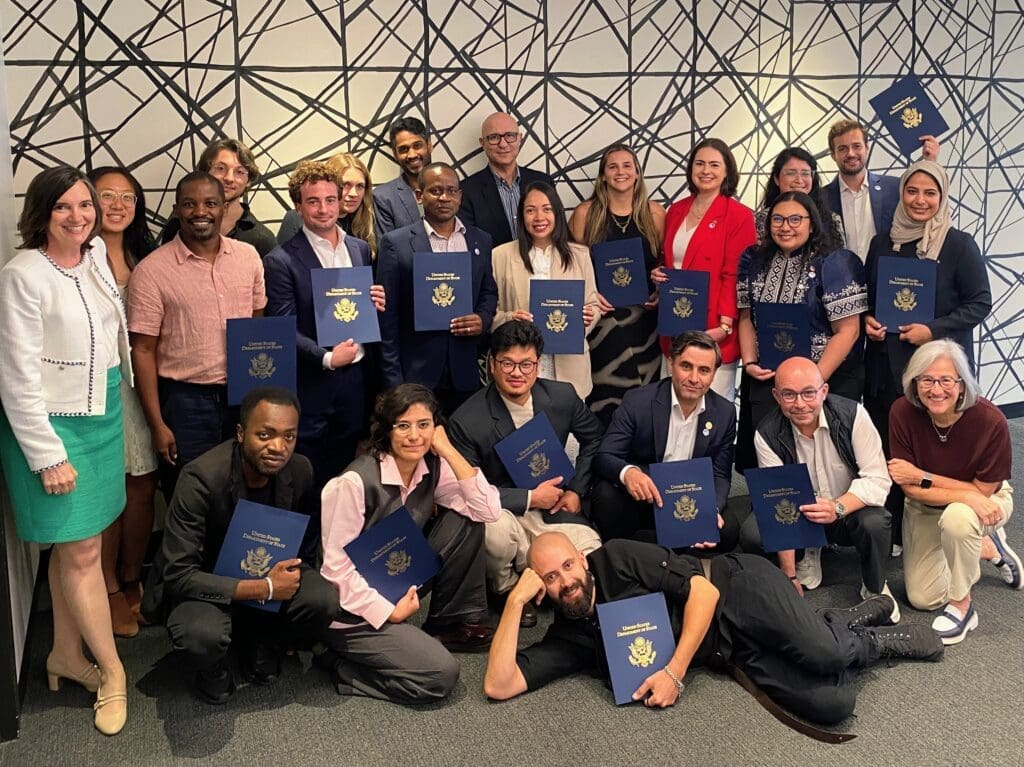
20 individuals were split into four groups across nine states. My group went to Burlington, Vermont, and Dallas, Texas.
Vermont’s lesson was that innovation isn’t accidental, it’s designed. Universities, startups, public institutions, and companies there work across disciplines. At the Vermont Intelligence Center, we saw how local, state, and federal agencies, including the FBI, use AI on data from fusion centers around the country for public safety, cybersecurity, and crime prevention. The takeaway: tools only matter after you’ve invested in people and their skills.
Texas was bigger and faster. In McKinney, growth runs on close ties between city government, universities, and business. We talked through the Texas AI Act, which tries to leave room for innovation while ruling out harmful uses. At Whiteglove AI, we saw automation and decision support already in production, I liked that it puts building power in the hands of the people closest to the problem, as citizen developers. We also got a look at quantum.
Beyond the meetings, we also experienced American culture. The Ben & Jerry’s factory and a cruise on Lake Champlain in Vermont; a rodeo in Texas, and the Fourth of July watching Young Washington, which tied back to our earlier visit to Mount Vernon.
Innovation Beyond Technology
The strongest impression from the program: AI innovation comes from ecosystems, not technology alone, universities, startups, government, and civil society all pulling toward the same goal. We saw it across healthcare, education, and agriculture, where the aim was making people and public services work better, not replacing them. Innovation meant solving real problems together, not just technical breakthroughs.
That same lesson applies to security. As AI becomes part of everyday life, security is getting as much attention as innovation. Experts kept circling back to the same priorities: data privacy, cybersecurity, misinformation and deepfakes, and AI that’s transparent and trusted. The takeaway: AI security isn’t just technical, it’s ethics, policy, education, and institutional readiness too.

A Global Network of Leaders
The most valuable part of IVLP was the relationships with professionals from different countries and backgrounds, all circling the same questions: how to use technology on real problems, and how to build AI responsibly.
Some of the best conversations happened off the agenda over meals, on long bus rides, hashing out what we’d just heard. Different countries, same questions: adoption, regulation, public trust.
I’m leaving with a network of peers I’ll keep learning from, relationships that matter as much as anything I learned in a session.

Lessons for Nepal
Nepal has a unique opportunity to shape its own AI future by learning from global experiences while building solutions for local challenges. To do that, we need to keep investing in its own models, digital skills, promoting responsible AI, and creating spaces where government, academia, startups, and civil society can work together.
One lesson from the IVLP was that there is no single roadmap for AI. Every country must build its own path. For Nepal, that means bringing together government, academia, startups, and civil society while staying connected to global networks that encourage learning, partnerships, and the responsible development of AI.
A Personal Reflection
The IVLP made one thing clear: AI is as much a societal shift as it is a technological one. The strongest AI ecosystems invest not only in technology but also in people, ethics, and institutions. Its future will be shaped by responsibility, trust, and collaboration across borders.
Beyond the knowledge and insights, the most valuable part of the program was building friendships and professional connections with leaders from around the world. I return to Nepal inspired by new ideas and excited to share these learnings with the Impact Hub Kathmandu community as we work towards an AI ecosystem that is ethical, inclusive, and benefits society.
My favorite idea from the program: AI is like a power tool. It can make your work faster and easier, but only if you already have the underlying skills, pick it up without that foundation, and you’re more likely to hurt yourself than get anything done.
I am grateful to the U.S. Department of State, the U.S. Embassy, the program organizers, and everyone who made this enriching experience possible.