What happens when waste is seen not as something to be discarded, but as a resource with economic and environmental value? For a growing group of entrepreneurs in Pokhara, the answer lies in innovation, persistence, and the opportunity to build businesses around a more circular future.
This vision took center stage at the Demo Day of the Recycling and Upcycling (RU) Business Incubation Program and Post-Incubation Support, held on 14 and 15 July 2026 at Hotel Barahi, Pokhara. The two-day event marked the culmination of a three-month incubation journey and brought together entrepreneurs and key stakeholders of the entrepreneurial ecosystem to celebrate the progress of participating businesses and explore their potential for further growth.
The program is implemented by Impact Hub Kathmandu as a part of the Green Job Creation through Recycling and Upcycling (GCRU) Project, implemented by the United Nations Development Programme (UNDP) with support from the Korea International Cooperation Agency (KOICA), in collaboration with Pokhara Metropolitan City (PMC).
Day One: Cohort 1 Takes the Floor
The first day opened with an informal networking session that gave entrepreneurs, jury members, and guests a chance to connect before the formal proceedings began. The inaugural session was led by Pravat Lamichhane, Section Chief of PMC’s Forest, Environment and Sanitation Department, with Mayor Dhana Raj Acharya attending as Chief Guest and Sudip Aryal, UNDP Nepal’s Field Office Head for Gandaki and Lumbini Provinces, joining as Distinguished Guest.
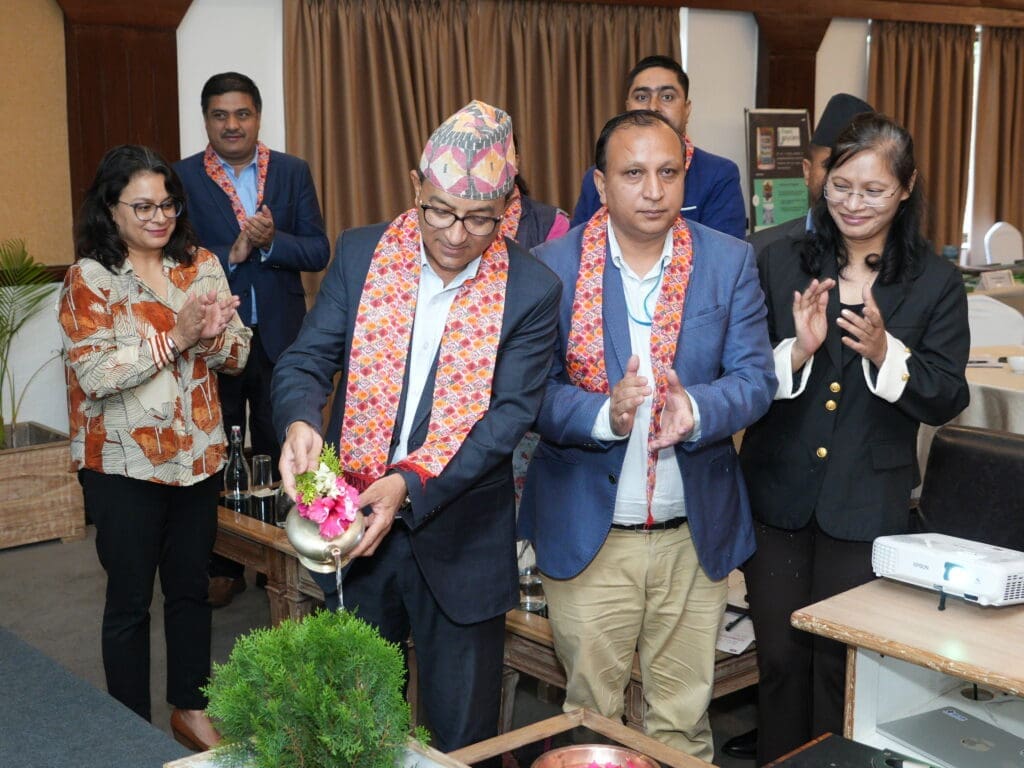
The event was inaugurated by watering the plant, reflecting the program’s commitment to growth, sustainability and lasting impact. Romi Shrestha, Communications and Outreach Officer of Impact Hub Kathmandu delivered the welcome note, followed by a presentation from Sajina Bhandari, Program Officer tracing the program’s three-month journey from its earliest days to Demo Day itself. Following remarks from Sudip Aryal, Head of Field Office UNDP, the inaugural session concluded with closing remarks from the Mayor.
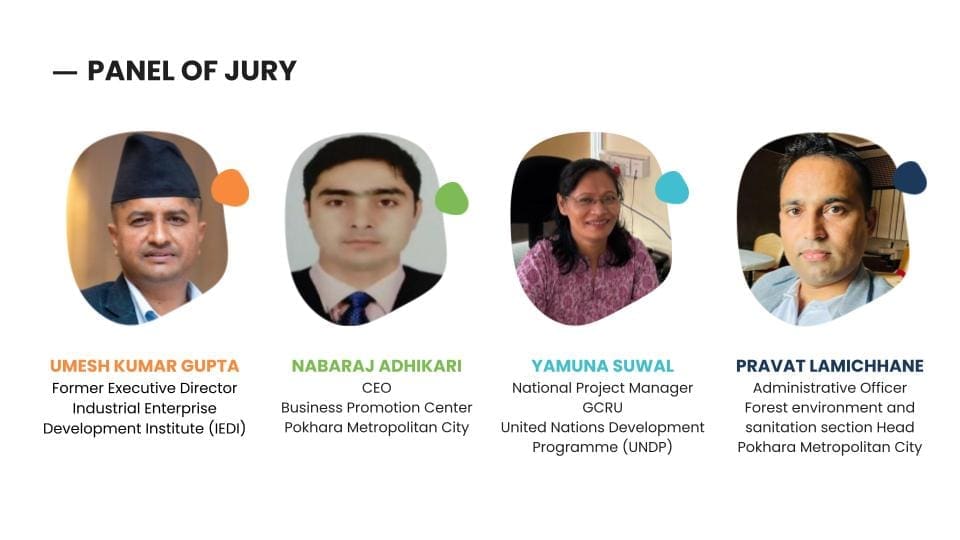
The four-member evaluation jury for the day comprised Nabaraj Adhikari (CEO, Business Promotion Center, PMC), Pravat Lamichhane (PMC), Umesh Kumar Gupta (former Executive Director, Industrial Enterprise Development Institute), and Yamuna Suwal (National Project Manager, GCRU Project, UNDP Nepal).
Nineteen incubatees took the stage over the course of the day, each given five minutes to present, followed by five minutes of Q&A round from the jury. Their pitches spanned business models, prototypes, market strategies, and financial plans, offering a clear picture of how far each idea had developed since the program began.
The specific business ideas presented by the companies included:
- ABiR Designers Hub plans to recycle used textiles into new fabrics.
- Bidhata Hastakala aims to create decorative items, bags, handicrafts and dolls from textile and paper waste.
- Bipul Subedi aims to craft statement furniture and interior design pieces from HDPE and PP plastic waste.
- Da Bista plans to upcycle textile, plastic, and metal waste into new products.
- Eco Family Pvt. Ltd. envisions producing tiles and lumber from multi-layer plastic (MLP) waste.
- Green Decision Labs and Research Pvt. Ltd. plans to create Polyplus toys from PP and PET plastic waste.
- Green Pravidhi Engineering Solutions Pvt. Ltd. aims to establish a waste bank and Integrated Resource Recovery Center (IRRC) to manage all types of waste and grow as a source of raw material for multiple recycling and upcycling enterprises.
- Himalayan Giant Nettle and Development Pvt. Ltd. plans to produce thread and textile products from used textile fiber.
- Kleanit Upcyclers Pvt. Ltd. envisions crafting furniture, sunglasses, and watches from low-value plastics.
- Kriti Bastola plans to produce paper bags from recycled print grade paper waste.
- Narayan Malla Thakuri (Rupesh) aims to create lamp cases, frames, and similar products from PET, HDPE, and ABS plastics.
- Opus Decor Pvt. Ltd. plans to produce flower pots from HDPE and PP plastic waste.
- Pooja Thapa envisions making egg cartons from cardboard and carton waste.
- Opus Design Atelier envisions creating statement furniture pieces and statues from underutilized engineering plastics, including e-waste plastics.
- Priyesh Chandra Neupane plans to produce tiles from construction and demolition waste.
- Sakal BioEnzyme Pvt. Ltd. aims to develop sanitary and cleaning products; such as shampoo and cleaning liquids; from organic waste like fruit peels.
- Shreejaya Tuladhar plans to produce insulation panels from plant waste, specifically rice husks.
- Sunil Yadav envisions making interlocking tiles from all types of waste.
- PawShu plans to produce stationery products from recycled paper waste.
Together, these companies embody the spirit of circular innovation, leveraging the incubation program to transition concepts into impactful, market-ready solutions targeting the transformation of waste management practices in Pokhara Metropolitan City, while contributing to the country’s overall circular economy goals.
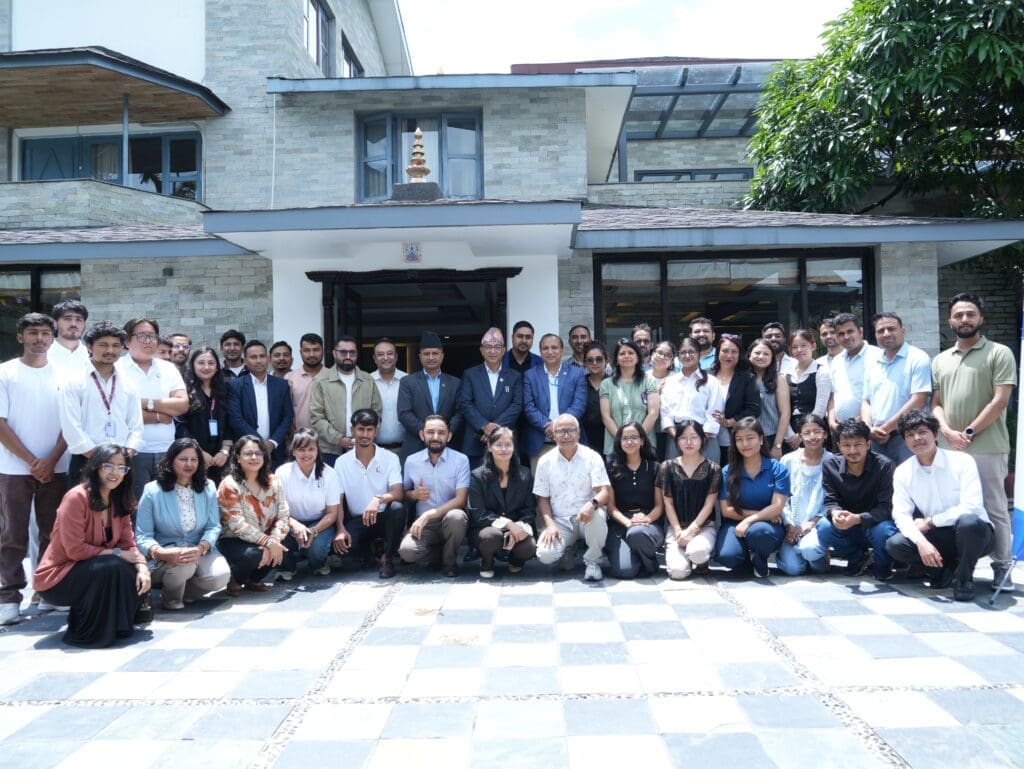
Once the presentations concluded, the jury moved into deliberation while attendees explored a gallery walk showcasing the entrepreneurs’ products and prototypes. The jury panel rigorously evaluated each business idea based on creativity, feasibility, impact potential, and scalability.
The day closed with an award ceremony. Among the 19 incubatees, nine enterprises were selected for Post-Incubation Machinery and Equipment Support were announced and presented with Certificates of Achievement and the day concluded with closing remarks from Pravat Lamichhane and Sudip Aryal.
Day Two: Creating Space for Inclusive Entrepreneurship
The second day was dedicated to Cohort 2: the Entrepreneurs with Disabilities (EwD) Cohort, providing a platform for participants to present their business ideas and aspirations to stakeholders and peers. Implemented in coordination with the National Federation of the Disabled – Nepal (NFD-N), Gandaki, the cohort reflected the program’s commitment to inclusive green entrepreneurship, ensuring the circular economy remains accessible to a broader range of entrepreneurs, and reinforcing that building it is about more than transforming materials; it is about creating inclusive pathways to economic participation.
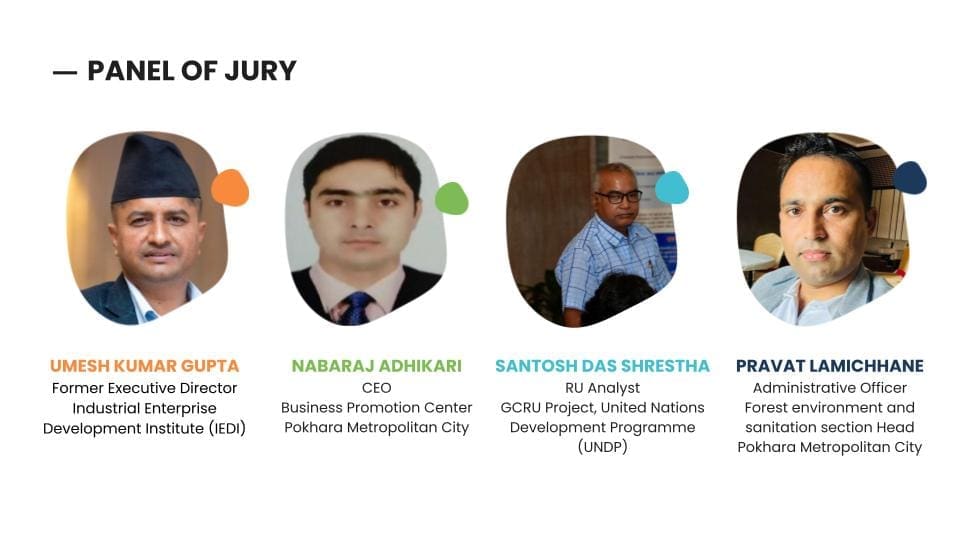
The formal session opened with remarks from Pravat Lamichhane, followed by Er. Bimal Ranjan Karki of PMC’s Urban Development, Tourism, Forest and Environment Division. Sudip Aryal then addressed the gathering, highlighting the importance of inclusive entrepreneurship and the role of collaborative partnerships in advancing circular economy initiatives. The evaluation jury for the day: Nabaraj Adhikari, Pravat Lamichhane, Umesh Kumar Gupta, and Santosh Das Shrestha (RU Analyst, GCRU Project); was then introduced, and participants were briefed on the pitching and evaluation process.
Four entrepreneurs from the EwD Cohort presented their businesses, each given eight minutes to pitch, followed by questions and answer sessions from the jury.
The specific business ideas presented by the entrepreneurs included:
- Disabled Women Empowerment Center- Kaski aims to recycle used papers and turn them into bookmarks, greeting cards, invitations cards and other products.
- Hem Bahadur Gurung plans to upcycle denim jeans into bags and earrings.
- Namuna Apanga Duna Tapari and Hastakala Udhyog want to replace paper and plastic plates with traditional duna and tapari made out of dried leaves, and turn low value plastics and banana fiber into floor mats and wall decoration items.
- Sambriddhi and Sushant Stores aim to give second life to PET bottles by reusing them as packaging materials for their cleaning products (harpic, phenyl, liquid soap).
The event also featured a gallery walk, where incubatees showcased their prototypes and products, offering guests an opportunity to explore their innovations and engage directly with the entrepreneurs.
Following the final evaluation, all four were also selected to receive Post-Incubation Machinery and Equipment Support, as their combined equipment requirements fell within the available support. The day concluded with remarks from Pravat Lamichhane, Er. Bimal Ranjan Karki, and Sudip Aryal, who congratulated the cohort on completing the program and encouraged them to continue building toward sustainable and inclusive green enterprises.
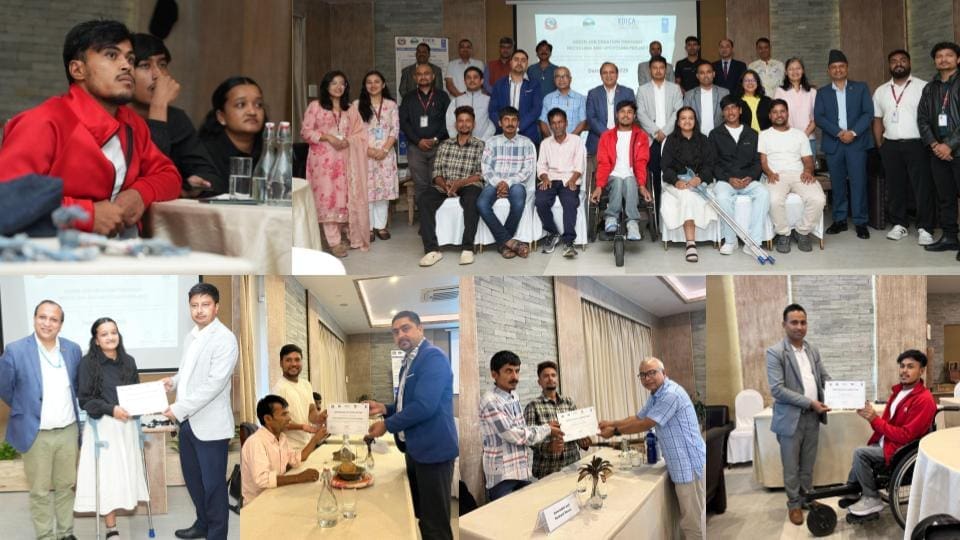
Mukti Ram Aryal, Chief Administrative Officer of Pokhara Metropolitan City, also visited the EwD cohort, toured the Gallery Walk, and spoke directly with entrepreneurs about their experiences and challenges, reaffirming PMC’s commitment to inclusive entrepreneurship and a more accessible, disability-friendly city.
From Incubation to the Next Stage of Growth
Demo Day marked not only the conclusion of the three-month RU Business Incubation Program, but also the beginning of the entrepreneurs’ next stage of growth. Following the evaluation, selected enterprises moved into the Post-Incubation Support phase, where they are receiving targeted assistance to finalize equipment specifications based on their business needs, followed by procurement.
This continued support, led by Impact Hub Kathmandu with UNDP Nepal through the GCRU Project, in collaboration with Pokhara Metropolitan City and with KOICA’s support, strengthened recycling and upcycling enterprises as they scaled their operations and contributed to a more inclusive and circular economy in Pokhara.
From ideas to enterprises and from waste to value, the journey continues toward a more circular and sustainable future for Pokhara.