Plastic to Ghar has been honoured with the prestigious Cambridge Collaboration Award 2025 recognising an extraordinary partnership between University of Cambridge researchers and communities across Nepal in transforming Himalayan plastic waste into Opportunity.
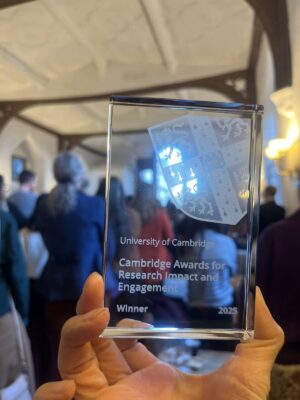
On 4 February 2026, the Plastic to Ghar (P2G) project was announced as the winner of the Cambridge Collaboration Award at the Cambridge Awards for Research Impact and Engagement ceremony, held in the University of Cambridge. Out of 87 applicants P2G was selected for the award which recognises the project’s exceptional model of cross-continental partnership and its transformative impact on communities and the environment across Nepal.
The Cambridge Awards for Research Impact and Engagement, established in 2016 as the Vice Chancellor’s Awards for Public Engagement, celebrate the processes and partnerships required to create significant economic, social, and cultural impact from research. The Collaboration Award, in particular, recognises team partnerships between University researchers, professional services staff, and external collaborators who together achieve outstanding impact and engagement.
About P2G and its Impact
Nepal’s Localised Circular Innovation Ecosystem
Plastic to Ghar (P2G), meaning “plastic to home” was born from a clear observation at Nepal’s plastic waste crisis. As the roof of the world, home to eight of the ten highest mountains, Nepal faces difficult challenges: rugged terrain, limited road networks, and prohibitive transport costs to make centralised waste management nearly impossible. A staggering 90% of solid waste is dumped or burned openly, with only 8% recycled.
P2G was launched in December 2021, led by the Centre for Industrial Sustainability (CIS) at the University of Cambridge, as a UK–Nepal Research Consortium with the Local Partner Impact Hub Kathmandu | FabLab Nepal. Together, the project was set out to establish localised circular economy ecosystems that transform local plastic waste into practical housing products, while incubating start-ups and empowering isolated communities.
Co-Creation at the Heart of Change
Over the four years, P2G engaged more than 70 local innovators, villagers, and students through MAKEathons, a multi-day open innovation event drawing participants from across Nepal, some travelling up to two days to attend. These events, held in Kathmandu, brought together multidisciplinary teams to ideate and prototype plastic upcycling solutions tailored to their own communities.
The most promising MAKEathon teams were then invited into a rigorous incubation programme, receiving masterclasses, technical and business coaching, pre-seed funding, networking opportunities, and access to the P2G Plastic Room, a hands-on prototyping space equipped with low-cost, locally appropriate recycling machines at FabLab Nepal.
- Local Innovators Engaged – 70+
- Circular Start-ups – 3
- Plastic Hubs – 5
- Jobs Created – 27
- Tonnes Diverted – 40+
- Tonnes/Year Capacity – 2,000+
Three Start-ups, Five Hubs, One Mission
P2G’s impact is most vividly embodied in the three start-ups and five distributed plastic hubs it has catalysed across rural and urban Nepal.
Paramendo
Born during the P2G MAKEathon and named after the Rhododendron in Tamang, Paramendo won first place for its solutions to local waste challenges in Ree Gaun, a remote Himalayan village. Despite no prior experience, the team is trying to upcycle Multi-Layer Plastic (MLP) packaging into roofing and flooring boards. Headquartered at Impact Hub Kathmandu, Paramendo operates the Himalaya Village Hub and is expected to expand to Ruby Valley.
KleanIt Upcyclers (KIU)
A social enterprise transforming HDPE, PP, and MLP into durable furniture and housing materials. KIU runs three urban plastic hubs in Dang, Kathmandu, and Pokhara, with a combined processing capacity of over 2,000 tonnes per year. In Dang, KIU formed a 15-year public-private partnership with the local government, employing 20 female waste workers. Over 160 upcycled plastic benches now sit along the Everest trekking route, at Pashupatinath temple, and in schools and skate parks.
Green Decision Labs (GD-Labs)
Placing second at MAKEathon #1, Green Decision Labs is exploring Polyfloss technology for thermal and acoustic insulation. They have expanded their polyfloss use to make plush toys and keyrings, another viable product in the market.
Together, these start-ups and their distributed hubs have diverted over 40 tonnes of plastic waste, created 20 full-time and seven part-time jobs, and demonstrated that locally-owned, financially self-sustaining circular economy ecosystems are not only possible, they are already happening.
Looking Ahead
P2G’s success is measured not by the end of its funded period, but by what continues without it. The start-ups have become an ecosystem in their own ways, securing land, machinery, partnerships, and procurement, and coordinating material flows independently of the founding consortium. What began as knowledge transfer has evolved into knowledge co-creation, with start-ups regularly solving challenges to test their products into the world.
Looking ahead, the P2G team will share its learnings widely at the upcoming Cambridge Festival 2026, where plans include launching an open-source Innovation Protocol and Manuals, releasing a documentary film, hosting panel discussions, and showcasing P2G products to the public. The team expects the circular economy ecosystems to mature over the years, with increased stakeholder participation, product diversification, and policy integration.
The Cambridge Collaboration Award is a recognition not just of a project, but of a proof of concept that by placing local communities at the centre, research can catalyse transformative and lasting change.