Nepal is presently experiencing a major waste crisis, where about 2.7 million tons of municipal solid waste are produced every year and only 8 percent of the same is recycled. The situation is especially severe in the fast urbanizing tourist centre of Pokhara, where the city produces about 182 tonnes of waste on a daily basis. A transformative effort to counter this, the so-called Green Job Creation through Recycling and Upcycling (GCRU) Project, is enabling the local entrepreneurs to transform the environmental liability to economic benefits.

Implemented by Impact Hub Kathmandu in partnership with the UNDP, KOICA, and Pokhara Metropolitan City, the project concluded a rigorous business incubation program. Out of an initial pool of 49 applicants, 20 applicants were selected for the incubation program in which six high-performing enterprises were selected to receive intensive technical support and equipment to scale their circular economy solutions.
Innovating the Circular Economy
The six projects below represent a non-homogeneous expression of the circular economy, which will seek to deal with various types of waste that are currently clogging landfills and rivers:
- Chillionaire Production: Chillionaire Production aims to reduce waste in urban areas by transforming discarded plastics and textiles to high-value artistic goods, such as home decor, installation art, and miniature do-it-yourself education products to children. The organization presents a locally produced option to the imported products by utilizing digital fabrication technologies, like 3D printers and laser cutters.
- Fully Charged Nepal: With the EV market in Nepal growing at a fast rate of over 13,000 units imports in the 2024/25 fiscal year, Fully Charged Nepal aims to address the new threat of battery waste. Fully Charged Nepal aims to recycle used lithium-ion batteries into safe and low cost second-life energy storage systems.
- Green Road Waste Management: Dedicated to the 9.1 tons of glass waste that Pokhara generates on a daily basis, Green Road Waste Management aims to recycle glass waste into glass sand and powder. These are materials that are environmentally friendly and can substitute natural river sands in the development of roads and production of bricks in place of devastating mining in the riverbeds.
- HattiHatti: HattiHatti is committed to the 1.82 metric tons of textile waste discharged in Pokhara each day, and recycles it into premium textile clothes and accessories. HattiHatti targets to minimize the amount of waste of Pokhara Municipality which ends up in landfills and to provide jobs to women belonging to marginalized groups.
- Kagaz Ghar: Kagaz Ghar is an eco-innovation that turns waste paper, which is discarded in schools and offices, into non-toxic products. Kagaz Ghar original brand consists of seed-infused paper which can be planted to form greenery, and which helps to promote an entirely sustainable way of living.
- Sanskar Fiber: Sanskar Fiber upcycles the plastic waste into polyester fiber by focusing on the enormous quantities of PET bottles by the hospitality industry. This is then recycled into a new fiber that is cheaply produced to make environmentally friendly quilts, pillows, and cushions.
Social and Environmental Impact
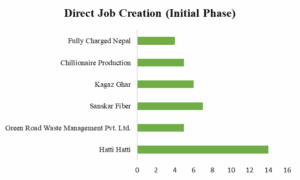
The project intends to put 30 RU businesses and generate more than 300 green jobs to the locals of Pokhara in 2029. The 14 formal job openings that HattiHatti alone intends to open are planned to be based on a workforce that is at least 60 percent women. On the same note, Sanskar Fiber will redirect the roughly 42 metric tons of PET bottles per year, at the same time giving technical training to local employees. Together, these enterprises are developing a waste-to-value attitude, and it is proving that caring about the environment can be smoothly combined with economic inclusion.
A Sustainable Future for Pokhara
Although the road towards a zero-waste city is difficult with inconsistent supply of raw materials being one of the risk factors as well as variations in the cost of energy, the GCRU project offers the dedicated training, financial counseling, and specialized equipment required to ensure that these startups survive and prosper.
The project offers these entrepreneurs an opportunity to network them to investors as well as government agencies so that the green revolution in Pokhara is established on the basis of financial feasibility and scalable innovation. When these enterprises start their full scale operations, Pokhara will become an excellent demonstration of how local communities can address global environmental issues by being creative and entrepreneurial.