On 19th March at the Ray Dolby Auditorium, the Plastic to Ghar (P2G) project took centre stage at the Cambridge Festival 2026, one of the world’s most prestigious public research events, for what proved to be a fitting final chapter of a four-year circular economy journey in Nepal.
The Cambridge Festival, the University’s largest annual public event spanning over 350 events across disciplines and running from 16 March to 2 April 2026, provided the international platform for P2G to share its story for the first time with a global audience. What filled the auditorium that afternoon was not simply a project report, but a living account of what happens when academic rigour meets community trust, and when plastic waste is treated not as a problem to be managed, but as a resource waiting for a second life.
Opening: A Film Premiere
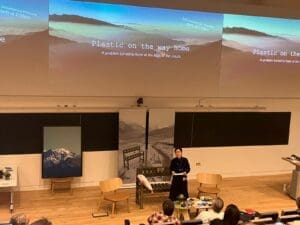
The afternoon opened with the premiere of Plastic on the Way Home, a short documentary that set the emotional tone for everything that followed.
Set against Nepal’s ancient philosophy that life is a circle and that every ending is simply a preparation for a new beginning. The film explored how plastic waste had broken that circle in one of the world’s most challenging environments. In Nepal’s high-altitude terrain, there is no practical infrastructure to bring waste down from the mountains. The result, for too long, had been open burning and dumping on slopes. P2G was built to change that.
The documentary journeyed first to Ree, a village of 115 homes nestled beneath the Ganesh Himal range, where startup Paramedo has been collecting, sorting, cleaning, and pressing plastic into boards that villagers now use to improve their homes. It then moved to the heart of Kathmandu, where KleanIt Upcyclers (KIU), founded after a friend challenged its creators to stop complaining about waste and start doing something about it, has transformed street and river plastic into furniture, interlocking tiles, and building materials. The company has provided employment to 20 female workers over 15 years and has earned rare formal recognition from the Nepali government for its contribution to waste management.
The film traced KIU’s journey from a roti maker experiment in a small kitchen to benches now standing along Everest trekking routes and at Pashupatinath, Nepal’s most sacred temple, silent witnesses to the most profound cycles of life. The documentary concluded where the project itself has always been rooted: in the conviction that isolation is not an excuse for standing still, and that empowering local communities to drive change is both possible and replicable.
Launching the P2G Knowledge Suite
Following the film, the P2G team took to the stage to unveil the P2G Knowledge Suite, a comprehensive collection of open-source resources distilling four years of on-the-ground learning from across the Himalayas.
The suite comprises four distinct publications. The Innovation Protocol which documents the full journey of how communities were engaged, challenges scoped, solutions co-created, and local ecosystems built from the ground up. Aimed at innovators, policymakers, and sustainable development practitioners, it captures, in the team’s own words, “what we wish we had known before.”
The Technical Toolkit covers the practical side of plastic recycling in resource-constrained settings, drawing on experience with twelve different machine types and including a decision matrix to help practitioners identify the most suitable equipment for their environment. The Safety Toolkit addresses the real risks involved while operating a recycling unit, with structured risk assessment guidance and a comprehensive checklist matrix.
A fourth resource, the Business Incubation Toolkit is in its final editorial stages. Focused on guiding early-stage entrepreneurs toward commercialization, it is expected to be made publicly available shortly.
The numbers behind the project illustrated the scale of what had been achieved: five local ecosystems, 20 products, three startups, five innovation hubs, more than 100 jobs, and over 5 tonnes of plastic converted. But the team was emphatic that the figures only told part of the story. What mattered most was self-efficacy : the moment communities realised they could create and own the solutions themselves.
Four lessons from the protocol were highlighted. First, knowledge was co-created rather than transferred. Communities became generators of knowledge, not just recipients. Second, progress came from adaptability, not rigid plans, with the biggest breakthroughs arriving when the team embraced pivoting and celebrated imperfect progress. Third, circular transition moves at the pace of community, demanding patience above almost everything else. Fourth, appropriate technology wins. Simple, time-tested machines that local entrepreneurs could fully own and maintain consistently outperformed more sophisticated alternatives.
The session closed with an open invitation: the model built in Nepal is relevant far beyond it in landlocked developing countries and in high-income settings alike, wherever waste goes unseen because it is too close to home.
Panel Discussion: Honest Reflections from the Field
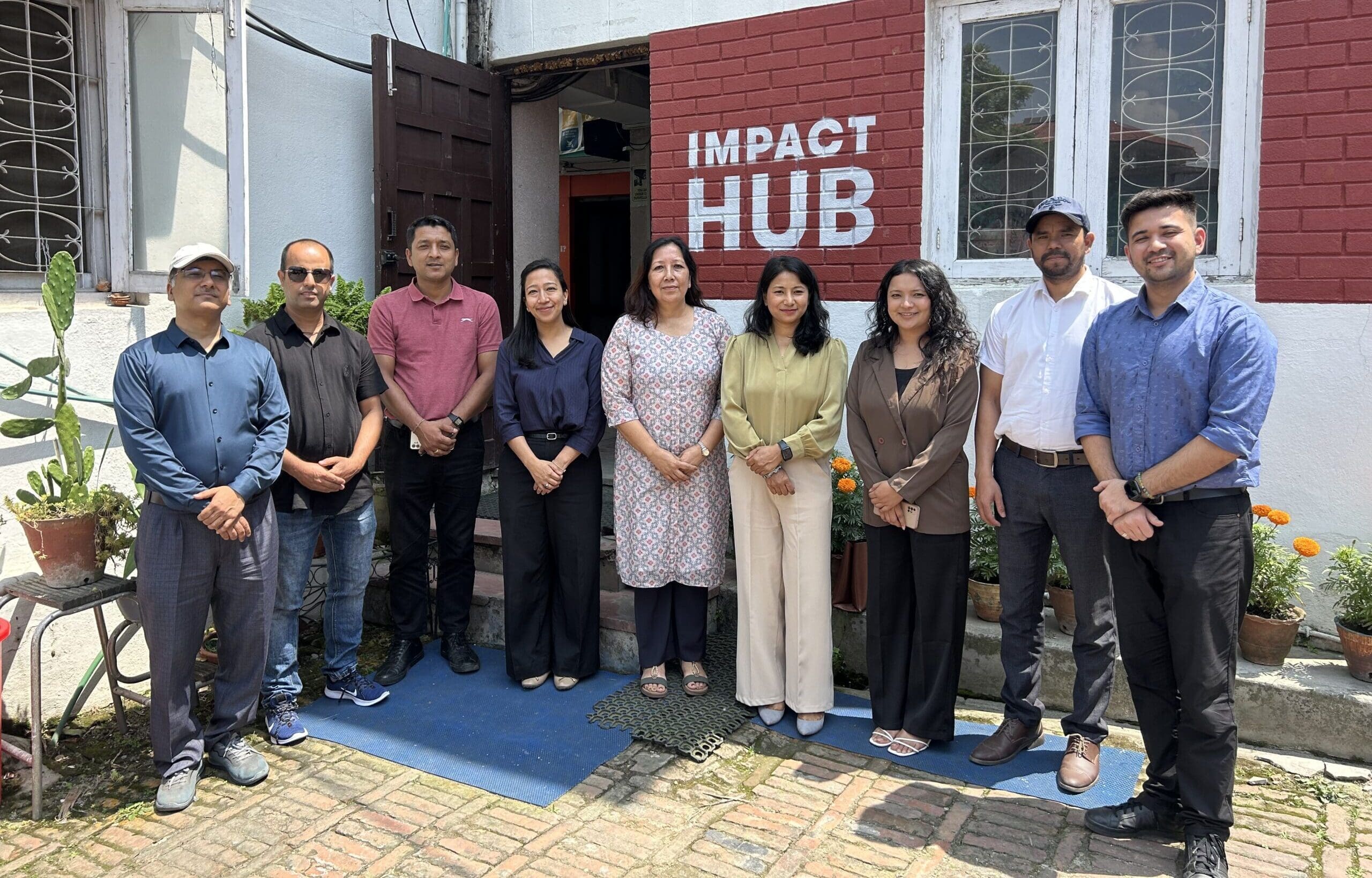
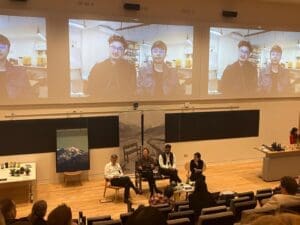
The afternoon’s centrepiece was a panel discussion chaired by Professor Steve Evans, Principal Investigator of P2G, and featuring Dr. Curie Park and Dr. Claire Barlow from the University of Cambridge, Pallab Shrestha from Impact Hub Kathmandu | FabLab Nepal, Milan Bohara from KleanIt Upcyclers, and Rahul Bisunkhe from Paramendo Nepal. With a moderator’s rule that every question must include a mountain metaphor, the conversation was as candid as it was illuminating.
Curie opened with a frank account of the project’s origins, a two-year initiative launched over coffee during COVID that initially aimed to deploy 30 recycling units and process 16.5% of Nepal’s plastic waste. In reality, getting even three units running proved a considerable challenge. What kept the project alive was a willingness to recalibrate, measuring success in knowledge built and communities empowered rather than tonnage alone.
Pallab Shrestha drew attention to one of the project’s most important technical lessons: that locally built machines, benchmarked against at least one quality imported model, consistently delivered better long-term outcomes than imported equipment. More fundamentally, he stated that placing a machine in a community without building genuine ownership around it was “like a body without a soul.”
Milan Bohara traced his journey from a US-educated entrepreneur returning to Nepal, frustrated enough by the waste crisis to build a business around it and to running three facilities across the country, each producing different products for their specific local market. His key insight was decentralised waste management with hyper-local products. Furniture sells in Kathmandu; souvenirs in Pokhara; interlocking bricks in the rapidly developing Dang region. Scaling, he claims, means understanding each locality on its own terms. He also described months of daily visits to government offices to secure approval for a plastic road project an experience that drew spontaneous applause from the audience.
Rahul Bisunkhe, described his journey with the community in Ree, where 115 households are now connected to a waste collection and recycling centre, stood as proof of what persistence and community trust could achieve.
The panel also addressed whether four years was simply the nature of this kind of work, or whether future projects could move faster. Curie’s answer was grounded in reality: Nepal’s rainy season closes roads through landslides, political strikes shut down the country without notice, and there is only a narrow spring window each year when outdoor fieldwork is truly possible. Beyond logistics, community trust cannot be a shortcut. Rahul added that every community has its own problems and its own pace of identifying them.
Looking ahead, the panel sketched an ambitious horizon. Curie spoke of replicating the model across the world’s 44 landlocked countries, 32 of which are classified as least developed. Pallab pointed to the need to address waste holistically : glass, paper, and medical waste alongside plastic. Milan outlined plans to expand pan-Nepal within five years, with revenue currently doubling annually.
The session closed with a reflection from Curie that captured the spirit of the entire project: the circular economy, she said, is rarely a clean circle. It is many messy, incomplete circles, both big and small, coming together. P2G has shown it can be done. And now it has written down how.
Upcycled Product Showcase
The day concluded with something more tangible: a display of upcycled plastic products crafted by P2G’s three startups, each piece a physical expression of everything the project had argued was possible.
Paramedo presented their PP pellet phone stands, a product that neatly captures the journey of Himalayan plastic from collected waste to functional everyday objects, and a tangible example of the startup’s ongoing work to find new uses for the plastic gathered from the communities they serve.
KleanIt Upcyclers brought their growing product range: the Everest bench, coffee tables, flower pots, coasters, combs, keyrings, and photo frames all made from MLP, HDPE, or PP waste collected across Nepal. Products that began as rough prototypes in neighbourhood gardens now stood as refined, commercially viable goods on a Cambridge stage.
Green Decision Labs showcased something altogether different: crochet animals crafted by local artisans and filled with Polyfloss, a lightweight wool-like material made from plastic waste, now being used for both insulation and an expanding line of plush toys.
A Circle Completed and Opened Again
By the time the Ray Dolby Auditorium emptied that evening, it was clear that what the audience had witnessed was not a conclusion but a handover. Four years of research, trial, error, patience, and community trust had produced not only products and jobs and recycled tonnes, but something rarer: a replicable model, a published roadmap, and a network of people in Nepal who no longer need to be told that change is possible because they have already made it happen.
P2G came to the Cambridge Festival to share what it had learned. It left with a room full of people asking where it goes next.