We would like to announce that four practitioners within the network of Fablab Nepal | Impact Hub Kathmandu (Asia Hub) have already passed the Making Spaces 3-STEP Approach Accredited Trainer Course. They have been awarded through this accomplishment as accredited trainers in the 3-STEP Approach to Equitable Makerspaces through MakingSpaces, a research project located at University College London.
This achievement is a significant milestone in en hancing equitable practices in makerspaces and other informal learning environments in STEM, especially in learning environments like Nepal where inclusive access to spaces of technology and innovation is developing.
Course Background and Objectives
The UCL MakingSpaces team has developed an international accreditation programme to increase the world capacity to practice equitably. The course united informal STEM education practitioners, community makerspaces practitioners, and innovation hub practitioners of various backgrounds. It also set out to not only enhance the knowledge of the participants about equity but also to prepare them with the instruments that they can use to make inclusive practices actively integrated in their own set-ups.
The participants were assisted throughout the programme to:
- Deepen their expertise in the 3‑STEP approach
- Learn to deliver equity‑oriented professional development for the sector
- Adapt the approach to be contextually relevant for their community
- Build a portfolio evidencing their training practice and impact
The course design was interactive workshops, facilitated pre and post session activities, optional monthly clinics, hands-on implementation projects with local practitioner communities. The last evaluated portfolio was needed to make sure that the participants not only mastered the concept of the framework but could also use it in practice.
Participants and course timeline
The programme, ran between February 2025 and October 2025, placed emphasis on learning and implementation. The UCL team collaborated with over seven makerspace organisations across the world as part of a global initiative to spread equitable makerspaces practices. Fablab Nepal | Impact Hub Kathmandu was among the most important regional partners that enabled the South Asian participation.
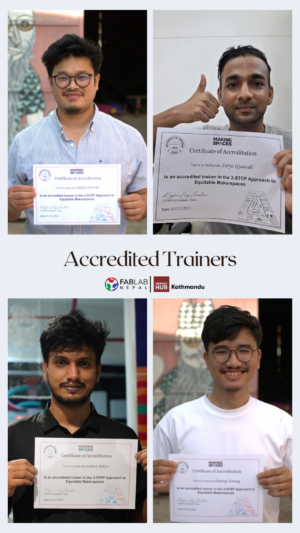
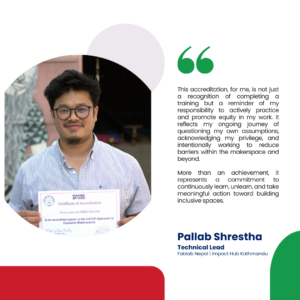
Through our network, four practitioners had been chosen : two from Fablab Nepal | Impact Hub Kathmandu, Pallab Shrestha and Denjing Tamang. The remaining two are from Karkhana Samuha, and Super Fablab Kerala : Surya Gyawali and Saheen Palayi respectively. During the nine months, these practitioners had weekly online sessions convened by the UCL team whereby they discussed the concepts and practices of equitable practice using the 3-STEP framework : Prepare, Do and Evaluate.
One of the best advantages of the programme was the focus on peer learning and knowledge dissemination. The four accredited practitioners having gone through training spread their learning to a larger ecosystem and they trained additional sixteen practitioners. These practitioners were a diverse group of fabricators, such as fab labs, community maker spaces, school-based robotics programmes, teachers and NGO-led STEM programmes. This progressive model of training greatly increased the coverage and amounts of the programme.
Impact
Other than training, there was also significant institutional change as a result of the project. The approach of 3 -STEP has been actively incorporated into Fablab Nepal | Impact Hub Kathmandu. This involves the inculcation of fair practices in community outreach, workshop design, programme implementation and facilitation practices. The organisation is striving to make the makerspaces more open and inclusive by making local languages, modifying tools to accommodate different learners, and promoting participatory learning spaces, among other things.
In summary, this project shows how international cooperation, based on local circumstances, can bring about systemic transformation. Not only is the individual capacity being developed through the accreditation but the overall ecosystem is being fortified, such that makerspaces grow to become inclusive, equitable, and community-centred learning environments.